KYC Integration Guide for Banks & Fintechs: How to Build a Secure Onboarding Flow
Learn how KYC integration works for banks and fintechs, including KYC APIs, identity verification, liveness detection, AML screening, risk-based onboarding, testing, and monitoring.
Digital banking has changed how customers open accounts.
Instead of visiting a branch, signing paperwork, and waiting for a manual verification process, customers can now download a financial app, enter their information, verify their identity, complete a biometric check, and begin using a product within minutes.
But while digital onboarding has made financial services more accessible, it has also created a more complex identity verification challenge.
A modern KYC integration needs to answer more than:
Does this identity exist?
It also needs to determine:
- Is this person the legitimate owner of the identity?
- Is a real person present during verification?
- Does the customer's information match trusted identity records?
- Is the customer associated with sanctions, PEP, or other financial-crime risks?
- Does the customer require enhanced due diligence?
- What should happen when verification fails?
- How should legitimate customers be approved without unnecessary friction?
- How can the business continue monitoring identity and fraud risk after onboarding?
For banks and fintechs operating across Africa, these challenges can be even more complex because identity databases, regulatory requirements, connectivity, documents, and customer behavior vary across markets.
This guide explains how to integrate KYC into a bank or fintech onboarding process, covering the product, compliance, engineering, fraud, and customer-experience considerations that matter when building a production-ready verification system.
What Is KYC Integration?
KYC integration is the process of connecting identity verification and customer due-diligence services to a company's customer onboarding workflow.
KYC stands for Know Your Customer.
Financial institutions use KYC processes to establish and verify the identity of customers before providing certain financial services.
A KYC integration allows your application to communicate with identity verification infrastructure through APIs, SDKs, hosted verification flows, or other technical interfaces.
Instead of manually checking every customer, your system can automate parts of the verification process.
A typical digital KYC workflow can include:
- Customer information collection
- Government ID verification
- Identity database verification
- Document verification
- Liveness detection
- Facial matching
- Phone or contact verification
- AML and sanctions screening
- Risk assessment
- Manual review
- Final onboarding decision
The exact combination depends on your product, target market, regulatory requirements, and risk profile.
There is no single KYC verification process that every fintech should copy.
A low-value digital wallet should not necessarily have the same onboarding requirements as a lending platform providing large credit facilities.
This is where risk-based KYC becomes important.
Why Is KYC Integration Important for Banks and Fintechs?
KYC is often treated as a regulatory requirement.
But your KYC system can directly affect the performance of your financial product.
A poorly designed KYC process can negatively impact:
- Customer acquisition
- Onboarding conversion
- Fraud losses
- Account activation
- Operational costs
- Customer support
- Regulatory compliance
- Customer trust
Consider a fintech with 10,000 users starting onboarding.
If 9,000 successfully complete verification, the business can potentially activate 9,000 customers.
But if only 6,000 complete verification because the process is slow, confusing, unreliable, or unnecessarily complicated, the company may lose 3,000 potential customers before they ever experience the product.
The opposite problem is also possible.
If verification is too weak, fraudsters can exploit the onboarding process.
The goal is therefore not:
Maximum verification.
The goal is:
The right level of verification for the right customer at the right point in the customer journey.
How Does KYC Integration Work?
A typical KYC API integration connects your application to one or more identity and compliance services.
A simplified architecture looks like this:
Customer
   ↓
Your Application
   ↓
KYC Orchestrator
   ↓
Identity Verification
   ↓
Biometric / Document Checks
   ↓
AML & Risk Screening
   ↓
Decision Engine
   ↓
Approve / Review / Retry / Reject
The important point is that the verification provider should not necessarily make every business decision.
The provider supplies verification signals and evidence.
Your application or decision engine determines what should happen next.
For example:
Identity verified
        +
Liveness passed
        +
Face match passed
        +
AML screening clear
        ↓
     APPROVE
Another customer might produce:
Identity verified
        +
Liveness passed
        +
Borderline face match
        ↓
   MANUAL REVIEW
This separation makes your architecture more flexible and easier to adapt as your business grows.
Before You Integrate KYC: Define Your Requirements
One of the biggest mistakes banks and fintechs make is selecting a KYC provider before defining their actual requirements.
The first question shouldn't be:
Which KYC API should we use?
It should be:
What risks are we trying to control?
Before writing code, define five things.
1. Who Are You Onboarding?
Your verification requirements depend heavily on your customer type.
Are you onboarding:
- Individuals?
- Businesses?
- Merchants?
- Agents?
- Drivers?
- Borrowers?
- Account holders?
- High-value customers?
For example, verifying an individual opening a low-value wallet is different from onboarding a company that will process millions of naira in transactions.
Your KYC architecture should reflect those differences.
2. Which Countries Are You Serving?
Your target markets determine which identity sources and verification methods you need.
For a Nigerian fintech, this could include:
- NIN
- BVN
- Nigerian passport
- Driver's licence
- Other supported identity documents
When expanding into Ghana, Kenya, or another African market, the available identity infrastructure and regulatory requirements may change.
This should be considered before development begins.
A multi-country fintech should avoid building a completely different verification architecture for every market.
Instead, create an abstraction layer where your application can simply request:
VERIFY_IDENTITY
while your verification infrastructure determines the appropriate identity source and verification method for that market.
This approach makes it easier to expand into new countries without rewriting your entire onboarding system.
3. What Level of KYC Verification Does Your Product Require?
Not every customer needs the same level of identity verification.
A practical approach is to create verification tiers.
Basic KYC
Useful for lower-risk onboarding.
Potential checks include:
- Customer information
- Government ID lookup
- Phone verification
Standard KYC
For products requiring stronger identity assurance:
- Government ID verification
- Document verification
- Face matching
- Liveness detection
Enhanced KYC
For higher-risk customers, products, or activities:
- Additional customer information
- Source-of-funds information
- Enhanced AML screening
- Additional documentation
- Manual review
- Increased transaction monitoring
Nigeria's CBN Customer Due Diligence framework provides for tiered customer due diligence and enhanced measures for higher-risk situations.
The principle is straightforward:
Don't make every customer go through your most expensive verification process.
Apply verification requirements proportionally to risk.
4. Do You Need AML Screening During KYC?
KYC and AML are closely related, but they are not the same thing.
KYC primarily establishes who the customer is.
AML controls help identify and manage financial-crime risks.
A modern onboarding process may therefore combine:
Identity Verification → Risk Assessment → AML Screening → Decision
Depending on your regulatory obligations, AML screening may include:
- Sanctions screening
- PEP screening
- Watchlists
- Adverse media
- Other relevant risk databases
One of the most important considerations is identity resolution.
A person named "Mohammed Ibrahim" appearing on a sanctions list does not automatically mean that your customer is the same person.
The system needs enough identity information to distinguish a genuine match from a false positive.
Your KYC and AML systems should therefore work together instead of operating as completely disconnected processes.
The KYC Onboarding Process: Step by Step
Once your requirements are clear, design the customer journey.
A good KYC onboarding flow should collect enough information to establish trust without creating unnecessary friction.
A typical process looks like:
Customer Signup
      ↓
Personal Information
      ↓
Identity Verification
      ↓
Document Verification
      ↓
Liveness Detection
      ↓
Face Matching
      ↓
AML / Risk Screening
      ↓
Decision Engine
      ↓
Approve / Review / Retry / Reject
Some checks can run simultaneously.
Others should only happen after a previous verification step has succeeded.
Step 1: Collect Customer Information
Start with the information your product actually needs.
Depending on the financial product, this might include:
- Full name
- Date of birth
- Phone number
- Email address
- Residential address
- Nationality
- Government ID number
- Occupation
- Other regulatory information
Avoid collecting information simply because your KYC provider makes it available.
Every additional field can create onboarding friction.
The better principle is:
Collect the information required to make the decision you need to make.
Step 2: Verify the Customer's Identity
The next step is confirming that the customer's information corresponds to a legitimate identity record.
For example:
NIN: 12345678910
Date of Birth: 01/01/1995
Your KYC infrastructure sends the information to the appropriate identity source and receives a structured result.
A conceptual response might look like:
{
  "verified": true,
  "identity": {
    "name": "John Doe",
    "date_of_birth": "1995-01-01"
  },
  "verification": {
    "source": "NIN",
    "status": "verified"
  }
}
However, production KYC systems should never assume that every result is simply:
true
or:
false
Real-world identity verification produces multiple outcomes:
- Verified
- Not found
- Suspended
- Partial match
- Low confidence
- Retry required
- Pending
- Service unavailable
- Manual review
Your backend should be designed around these states.
Step 3: Add Liveness Detection
Identity information alone does not prove that the person completing onboarding is physically present.
A fraudster could potentially have:
- Another person's identity number
- A stolen identity document
- A photograph
- A compromised account
- Manipulated biometric media
Liveness detection helps determine whether a real person is present during remote verification.
A liveness flow may ask the customer to:
- Look at the camera
- Turn their head
- Blink
- Follow a randomized instruction
- Capture a short video
Liveness is particularly useful for remote onboarding because it adds another layer of assurance beyond static identity information.
However, liveness should not be treated as a complete fraud-prevention system.
It is one signal within a broader identity and risk decision.
Step 4: Perform Face Matching
After obtaining a trusted reference image, compare it with the customer's live selfie or video.
The goal is:
Does the person presenting themselves match the identity being verified?
A strong identity verification flow can therefore combine:
Identity Record + Reference Photo + Liveness + Face Match
rather than relying on a single image comparison.
Face-match thresholds should be tested against your actual customer population and risk requirements.
A borderline result should not necessarily mean immediate rejection.
Depending on your risk model, you could:
- Request another capture
- Use another verification method
- Send the case for manual review
- Apply additional fraud checks
Step 5: Run AML and Sanctions Screening
Once identity has been sufficiently established, perform the appropriate AML screening.
Consider two customers with the same name:
Mohammed Ibrahim
If you search a sanctions list before properly resolving the customer's identity, you could generate a false positive.
Identity resolution provides the context needed to interpret screening results.
Your system should distinguish between:
Potential match
and:
Confirmed match
This is an area where automation should support compliance teams rather than blindly replacing human judgment.
Step 6: Make a Risk-Based KYC Decision
Don't reduce the entire KYC process to:
verified = true
Create a decision layer that considers multiple signals.
For example:
LOW RISK
→ Approve

MEDIUM RISK
→ Additional verification

HIGH RISK
→ Enhanced due diligence / Manual review

FAILED
→ Retry or reject
The KYC provider supplies evidence.
Your business decides what that evidence means for onboarding.
Build Your KYC Architecture Around an Orchestration Layer
One of the most important engineering decisions is separating verification from decisioning.
Don't tightly couple your application to one KYC provider's API response format.
Instead, create an internal verification model.
For example:
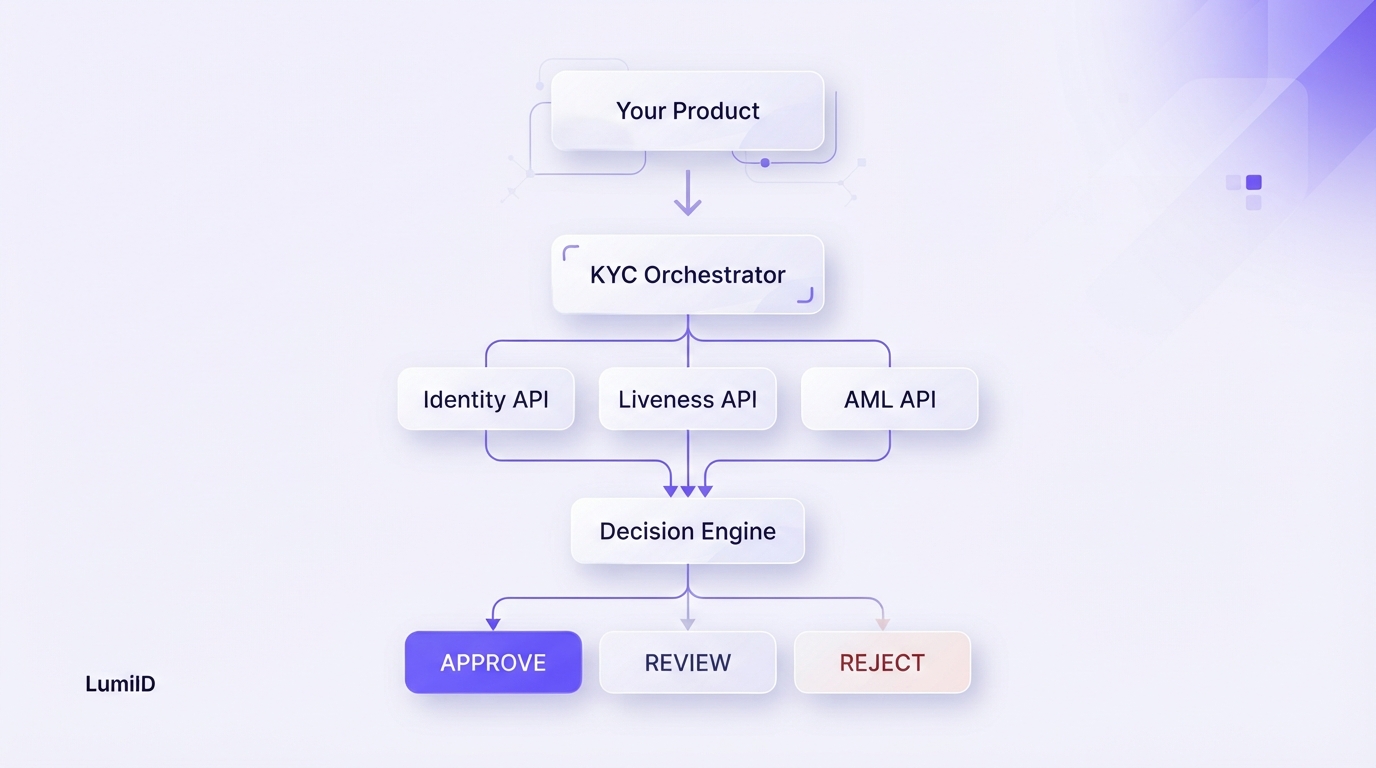
This architecture provides several advantages.
Provider flexibility
You can change providers without rewriting your entire application.
Multi-country support
Different identity sources can be plugged into the same verification architecture.
Better fraud intelligence
Additional fraud signals can be incorporated into your decision engine later.
Better observability
Your system can track every verification attempt and its outcome.
What Happens When KYC Verification Fails?
A KYC system that only handles successful verification is not production-ready.
Real customers will encounter:
- Poor internet connectivity
- Incorrect information
- Expired documents
- Unsupported documents
- Poor camera quality
- Liveness failures
- Partial name matches
- Database timeouts
- Provider downtime
- Duplicate submissions
- Suspended identities
Every one of these situations needs a defined response.
Instead of showing:
Verification failed.
Give the customer actionable information:
We couldn't verify your identity because the document image is unclear. Please upload a clearer image.
This small UX improvement can make a major difference to onboarding completion.
Not Every KYC Failure Should Result in Rejection
Consider three examples.
Poor image quality
Action: Allow the customer to retry.
Borderline face match
Action: Request another capture or send the case for manual review.
Identity record not found
Action: Stop the verification process or provide an appropriate alternative.
This is why a production KYC API should return reason codes and verification states, not just pass/fail results.
Build Manual KYC Review Into Your System
Automation should handle straightforward cases.
Human reviewers should handle cases requiring judgment.
A useful manual-review interface can contain:
- Customer information
- Verification results
- Confidence scores
- Failed checks
- AML screening results
- Documents
- Verification timestamps
- Device/session information
- Previous verification attempts
- Reviewer decision
- Reason for decision
This creates an audit trail and gives compliance teams the context required to make informed decisions.
Design Your KYC Integration for Provider Downtime
Every KYC provider can experience:
- Network problems
- Database outages
- API latency
- Rate limits
- Scheduled maintenance
- Partial outages
Your onboarding system should continue behaving predictably when the provider is unavailable.
Implement:
Retry logic
Retry temporary failures where appropriate.
Timeouts
Never leave customers waiting indefinitely.
Fallback verification
Where permitted by your compliance framework, provide another verification path.
Idempotency
Prevent duplicate verification requests when customers refresh or retry.
Status tracking
Track states such as:
pending
processing
verified
failed
manual_review
This becomes especially important for asynchronous verification workflows.
Webhooks vs. Synchronous KYC API Responses
Many identity verification platforms support both synchronous API responses and webhooks.
A typical asynchronous flow looks like:
Customer submits verification
        ↓
Your backend creates verification
        ↓
KYC provider processes verification
        ↓
Provider sends webhook
        ↓
Your backend validates webhook
        ↓
Verification status updated
        ↓
Customer onboarding continues
Your webhook implementation should handle:
- Duplicate events
- Out-of-order events
- Invalid signatures
- Unknown verification IDs
- Provider retries
- Network failures
Never assume a webhook will arrive exactly once.
Your webhook handlers should be idempotent.
How to Test a KYC Integration Before Launch
A sandbox is not only for checking whether your API connection works.
It should be used to test your entire onboarding decision system.
Test successful scenarios.
But spend significant time testing failures.
| Scenario | Expected outcome |
|---|---|
| Valid identity | Approve |
| Invalid identity | Reject |
| Suspended identity | Review / Reject |
| Partial name match | Additional check |
| Liveness failure | Retry |
| Face mismatch | Review / Retry |
| Expired document | Retry |
| Poor image quality | Retry |
| AML potential match | Manual review |
| AML clear | Continue |
| Provider timeout | Retry |
| Duplicate request | Idempotent response |
| Duplicate webhook | Ignore duplicate |
| Provider unavailable | Graceful fallback |
Testing these scenarios before production helps prevent failures from reaching real customers.
Don't Test Only the KYC API
Your engineering team might see:
HTTP 200
and conclude that everything works.
The customer might see:
Something went wrong.
Those are very different outcomes.
Test the entire onboarding journey:
Signup → Data Entry → Identity Verification → Document → Selfie → KYC Decision → Account Activation
Measure how long each step takes.
Test what happens when the customer:
- Goes offline
- Closes the browser
- Refreshes the page
- Submits twice
- Changes devices
- Fails verification
- Returns later
Production KYC is a customer experience, not just an API call.
KYC Security and Data Protection
Identity data is highly sensitive.
A KYC integration should therefore minimize unnecessary data collection and exposure.
Consider implementing:
- Encryption in transit
- Encryption at rest
- Role-based access control
- Audit logs
- Secure API authentication
- Secret management
- Data retention policies
- Data deletion procedures
- Vendor security assessments
- Incident-response procedures
Do not store identity documents or biometric information simply because your system can.
Store only what your business and regulatory obligations require.
Your compliance and security teams should establish data-retention, access, and deletion requirements before production deployment.
KYC Monitoring: What Should You Track After Launch?
Launching your KYC integration is not the end.
It is the beginning of understanding how the system performs with real customers.
Track metrics including:
1. First-Attempt Verification Rate
How many customers successfully verify without repeating the process?
A low rate may indicate:
- Poor UX
- Incorrect thresholds
- Image-quality problems
- Data-quality issues
- Provider performance problems
2. KYC Completion Rate
How many customers who start verification actually complete it?
3. Verification Drop-Off by Step
Identify where customers abandon onboarding.
For example:
Signup              10,000
Start verification   9,000
ID submitted         8,600
Liveness completed   7,900
Verified             7,500
This provides much more insight than one overall conversion number.
4. Average Verification Time
How long does it take a legitimate customer to become verified?
5. False-Positive Rate
How often are legitimate customers incorrectly flagged?
6. Manual-Review Rate
What percentage of cases require human intervention?
7. Fraud Detection Rate
How many suspicious or fraudulent attempts are detected?
KYC Metrics Are Business Metrics
KYC performance isn't only a compliance concern.
It can directly affect revenue.
Suppose your verification completion rate increases from 70% to 85%.
That can mean more customers successfully activate their accounts.
Likewise, reducing false positives can reduce:
- Customer support tickets
- Manual review workload
- Customer frustration
- Lost revenue
Your compliance dashboard and product dashboard should therefore work together.
How to Choose a KYC Provider
Don't choose a KYC provider simply because it has an API.
Evaluate the entire verification infrastructure.
1. Identity Coverage
Does the provider support the countries and identity sources you need?
For an African fintech, country coverage can be particularly important.
2. Verification Capabilities
Can the platform support the checks your product requires?
For example:
- Identity database verification
- Document verification
- Liveness detection
- Face matching
- AML screening
- Risk signals
3. Reliability
Ask:
- What happens when an identity source is unavailable?
- What is the provider's uptime?
- How are incidents communicated?
- Does the platform support retries and asynchronous processing?
4. Clear Verification Responses
Your application should be able to distinguish between:
- Verified
- Not found
- Suspended
- Partial match
- Failed
- Pending
- Manual review
5. Developer Experience
Look for:
- Clear API documentation
- Sandbox access
- Webhooks
- SDKs where appropriate
- Test scenarios
- Useful error messages
- API versioning
- Good developer support
6. Security and Compliance
Evaluate:
- Data handling
- Data residency where relevant
- Data retention
- Access controls
- Encryption
- Auditability
- Compliance documentation
- Security certifications where applicable
7. Scalability
Your KYC provider should work when you're processing:
100 verifications per day
and when you're processing:
100,000+ verifications per day.
8. Pricing and Commercial Transparency
Understand exactly what you're paying for.
Ask about:
- Successful verification
- Failed verification
- Retries
- Cached responses
- Liveness checks
- AML screening
- Manual reviews
- Minimum commitments
- Volume pricing
Unexpected verification costs can become significant as your customer base grows.
KYC Integration Checklist for Banks and Fintechs
Product
- [ ] We have defined who we're onboarding.
- [ ] We have identified the risks we need to control.
- [ ] We know which verification checks are required.
- [ ] We have designed the onboarding journey.
- [ ] We have defined verification tiers.
Compliance
- [ ] Our KYC process aligns with applicable regulations.
- [ ] We have defined when enhanced due diligence is required.
- [ ] We have defined AML screening requirements.
- [ ] We have defined manual-review procedures.
- [ ] We have defined data retention and access policies.
Engineering
- [ ] API authentication is securely implemented.
- [ ] Verification requests are idempotent.
- [ ] Webhooks are validated.
- [ ] Duplicate events are handled.
- [ ] Timeouts and retries are implemented.
- [ ] Provider downtime is handled gracefully.
- [ ] Verification states are persisted correctly.
Fraud Prevention
- [ ] Liveness is implemented where appropriate.
- [ ] Face matching is configured appropriately.
- [ ] Risk thresholds are defined.
- [ ] Suspicious cases can be routed to review.
- [ ] Verification attempts are logged.
- [ ] Fraud signals can be correlated with other events.
Testing
- [ ] Successful verification has been tested.
- [ ] Failed verification has been tested.
- [ ] Partial matches have been tested.
- [ ] Liveness failures have been tested.
- [ ] AML matches have been tested.
- [ ] Provider timeouts have been tested.
- [ ] Duplicate webhooks have been tested.
- [ ] The complete customer journey has been tested.
Monitoring
- [ ] First-attempt pass rate is tracked.
- [ ] KYC completion rate is tracked.
- [ ] Drop-off by onboarding step is tracked.
- [ ] Verification time is tracked.
- [ ] False positives are tracked.
- [ ] Manual-review rates are tracked.
- [ ] Fraud detection outcomes are tracked.
How LumiID Helps Businesses Build Better KYC Infrastructure
At LumiID, we believe KYC infrastructure should do more than return a verification result.
It should help businesses build a reliable trust decision layer.
LumiID provides identity verification infrastructure designed to help businesses integrate verification into their digital onboarding workflows.
Depending on the use case, businesses can build workflows around:
Identity Verification
Verify customer identities against supported identity sources.
NIN and BVN Verification
Build Nigerian identity verification workflows for financial products and digital businesses.
Liveness Detection
Help determine whether a real person is present during remote verification.
Face Matching
Compare a customer's captured face against an available identity reference.
Document Verification
Validate supported identity documents where required.
Business Verification
Support KYB workflows by verifying business registration information.
AML and Risk Screening
Support customer screening and risk-management workflows where applicable.
Verification Decisioning
Use structured verification outcomes to determine whether a customer should be approved, asked to retry, or sent for manual review.
But identity verification is only one part of the problem.
A customer can pass KYC today and become risky tomorrow.
That's why the future of KYC is moving beyond one-time verification toward identity intelligence, continuous trust, and fraud prevention.
The opportunity is to connect identity verification with behavioral signals, fraud intelligence, device information, and customer activity to understand trust throughout the customer lifecycle.
KYC Should Be an Infrastructure Layer, Not a Roadblock
The best KYC systems don't make customers feel like they're fighting compliance.
They make verification almost invisible when everything is normal—and become more rigorous when risk requires it.
The principle is:
Low-risk customer → Low friction
Higher-risk customer → Stronger verification
Suspicious customer → Additional investigation
Confirmed risk → Appropriate action
This is the foundation of modern risk-based onboarding.
The objective isn't to verify every customer in exactly the same way.
It is to gather enough reliable evidence to make the right decision.
The Future of KYC: From Verification to Identity Intelligence
Traditional KYC largely asks:
Who is this customer?
Modern identity infrastructure needs to answer a broader question:
Can we trust this customer in this context?
That requires more than a single identity lookup.
It may involve:
- Identity verification
- Biometrics
- Device intelligence
- Behavioral signals
- Transaction patterns
- Fraud indicators
- Network relationships
- Continuous risk monitoring
This is the direction in which identity verification and fraud prevention are converging.
For fintechs, that means KYC should not be designed as an isolated onboarding feature.
It should become part of the broader identity and risk infrastructure of the business.
Final Thoughts: Building a Production-Ready KYC Integration
Building KYC for a bank or fintech is not simply a matter of connecting an API.
The API is only one component of the system.
A production-ready KYC implementation requires:
Reliable identity data
→ The right verification checks
→ Risk-based decisioning
→ Strong failure handling
→ AML controls
→ Good customer experience
→ Secure engineering
→ Continuous monitoring
The regulatory environment is also moving toward stronger automated controls.
In Nigeria, regulatory guidance is increasingly emphasizing automated AML/CFT/CPF controls, stronger identity verification, and fraud monitoring for relevant financial institutions.
At the same time, FATF guidance recognizes that reliable digital identity can support customer due diligence when its assurance, reliability, architecture, and governance are appropriately assessed and applied using a risk-based approach.
The direction is clear:
KYC is becoming more digital, automated, risk-based, and connected to fraud prevention.
For banks and fintechs, the question is no longer simply:
How do we verify customers?
The more important question is:
How do we build an onboarding system that establishes trust, manages risk, satisfies regulatory obligations, and still allows legitimate customers to get started quickly?
That is the real KYC integration challenge.
And solving it well can turn identity verification from an onboarding bottleneck into a competitive advantage.
Frequently Asked Questions About KYC Integration
What Is KYC Integration?
KYC integration is the process of connecting identity verification, biometric checks, AML screening, and related customer due-diligence services to a bank or fintech's onboarding workflow.
How Does KYC API Integration Work?
A KYC API allows your application to send customer information to an identity verification service and receive structured verification results. Your application can then use those results to approve, reject, retry, or manually review the customer.
What KYC Checks Should a Fintech Use?
There is no universal combination. Depending on the product and risk level, a fintech may use government ID verification, document verification, liveness detection, face matching, AML screening, address verification, and additional fraud or risk checks.
Should KYC and AML Be Integrated?
They should work together, but they solve different problems. KYC establishes customer identity, while AML controls help identify and manage financial-crime risk.
Should Every Customer Go Through the Same KYC Process?
Not necessarily. A risk-based approach allows businesses to apply different verification requirements depending on customer, product, transaction, geographic, and other relevant risks.
What Happens When KYC Verification Fails?
A failed check does not always require immediate rejection. Depending on the reason, the customer may be allowed to retry, provide additional information, use another verification method, or be routed to manual review.
How Long Does KYC Integration Take?
The timeline depends on the number of verification methods, countries, identity sources, compliance requirements, security requirements, and engineering architecture involved. A simple integration can be relatively quick, while a multi-country bank-grade implementation requires considerably more planning and testing.
What Should Banks and Fintechs Monitor After KYC Integration?
At minimum, monitor first-attempt verification rate, KYC completion rate, drop-off by onboarding step, verification time, false-positive rate, manual-review volume, verification failures, provider performance, and fraud outcomes.
What Is the Difference Between KYC and Identity Verification?
Identity verification is one component of KYC. KYC is the broader customer due-diligence process, which can include identity verification, risk assessment, AML screening, enhanced due diligence, record keeping, and ongoing monitoring.
What Is a KYC Verification API?
A KYC verification API is a software interface that allows a business to programmatically submit customer information for identity verification and receive structured verification results.
Build Better Onboarding. Verify With Confidence.
LumiID provides modern identity verification and identity intelligence infrastructure for businesses building trusted digital experiences.
Ready to simplify KYC integration?