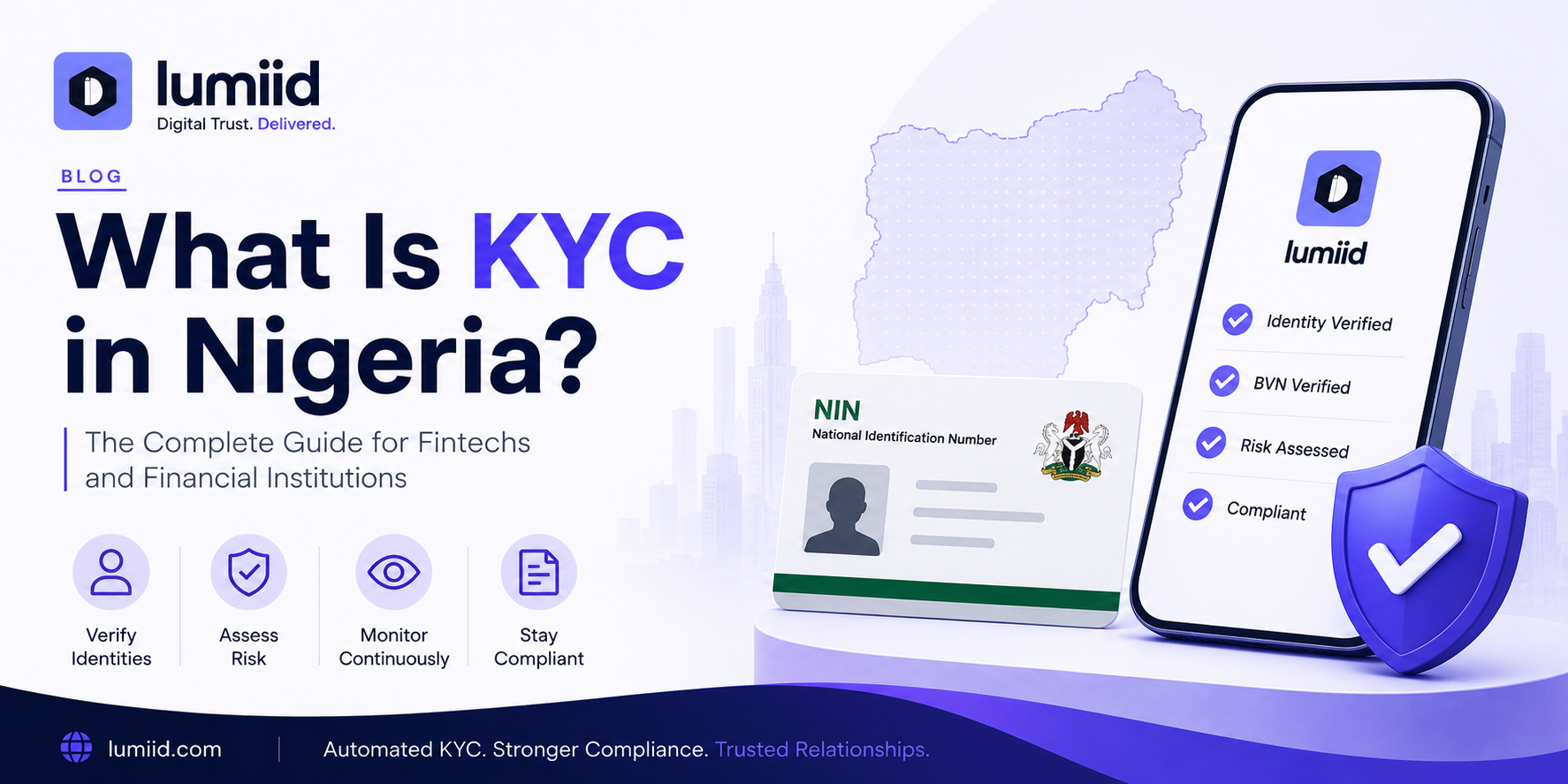
What Is KYC in Nigeria? The Complete Guide
What does KYC actually mean?
KYC stands for Know Your Customer. It's the process banks, fintechs, and other regulated businesses use to confirm who a customer really is and how much risk they carry before letting them open an account or move money. In Nigeria, this isn't optional. The Central Bank of Nigeria (CBN) lays it out in its KYC Manual for Banks and Other Financial Institutions, which requires every regulated business to collect proof of identity before offering services. Globally, the same idea sits at the heart of the Financial Action Task Force's (FATF) Customer Due Diligence standards, which most countries Nigeria included have built their own rules around.
Strip away the jargon and KYC is really just one question: do we actually know who we're doing business with?
In Nigeria, KYC obligations are enforced by the CBN and backed by the Money Laundering (Prevention and Prohibition) Act, along with other AML/CFT regulations. These rules apply broadly banks, fintechs, other financial institutions, and certain non-financial businesses all fall under them. Why KYC matters more than ever right now
For a while, KYC felt like a box-ticking exercise. That's changed. As mobile banking, lending apps, and remittance platforms have grown, regulators have gotten a lot more serious about how identity gets verified and they're backing it with real enforcement. In 2024 alone, the CBN fined 29 banks a combined ₦15 billion for AML and counter-terrorism financing violations.
Then things tightened further. On March 10, 2026, the CBN rolled out its Baseline Standards for Automated AML Solutions. The message was blunt: manual checks and siloed compliance systems no longer cut it. Institutions are now expected to keep a single, connected view of each customer their verified identity, risk profile, transaction history, and how any flagged activity was investigated.
To make the shift manageable, the CBN gave Deposit Money Banks 18 months and other financial institutions 24 months (from March 2026) to get their automated AML systems in place, along with a required implementation roadmap. This move lines up with Nigeria's broader push to stay aligned with international standards after coming off the FATF Grey List in October 2025. Bottom line for fintechs: verifying someone at sign-up isn't enough anymore. Compliance has to run continuously ongoing monitoring, risk scoring, and fast detection of anything unusual. Businesses that get ahead of this aren't just avoiding fines; they're building the kind of trust that lets them scale.
The three pillars of KYC
A solid KYC program rests on three things working together, not three separate checkboxes.
1. Customer identification, who are they?
This is step one. Before anyone gets access to financial services, a business has to confirm they are who they say they are. Nigeria uses a tiered system, so how much verification is needed depends on the account type and transaction limits involved.
A Tier 1 account, for example, usually just needs a name, address, date of birth, phone number, gender, and a passport photo. Move up to higher tiers or bigger transaction limits, and you'll need a Bank Verification Number (BVN), National Identification Number (NIN), and a valid government ID National ID, international passport, driver's licence, or voter's card. Identity checks don't necessarily stop at onboarding, either. If someone's activity suddenly jumps beyond what their account tier allows, the institution may need to re-verify them before letting transactions go through.
2. Customer due diligence, how risky are they?
Knowing who someone is only answers half the question. The next step is figuring out how much risk they bring. Most customers are low risk and only need standard checks. But some politically exposed persons (PEPs), people from high-risk jurisdictions, or businesses with tangled ownership structures need Enhanced Due Diligence (EDD). That can mean digging into source of funds, source of wealth, and sometimes getting sign-off from senior management before the relationship even starts. And risk isn't static. As behavior or transaction patterns shift, that risk rating needs to be revisited.
3. Ongoing monitoring, are they still who we thought?
This is the pillar that gets skipped most often, and it's arguably the most important one now. Regulators don't want a one-time check at onboarding they want continuous monitoring. That means watching for anything odd: sudden spikes in transaction volume, cross-border transfers, structured transactions designed to dodge reporting thresholds, or any other red flags. When behavior changes, the risk profile gets reassessed, and sometimes the customer goes through identity verification and due diligence again.
Together, these three pillars answer three connected questions: who is this person, how risky are they, and how is that risk changing over time? The CBN expects institutions to treat these as one connected system, not three separate databases. Records also need to be kept for at least five years after the relationship ends so record-keeping is very much part of the job.
How a typical KYC process actually works
1.Collect basic info. For lower-risk accounts, that's name, address, date of birth, phone number, gender, and a photo matching CBN Tier 1 requirements.
2.Verify identity. Higher tiers or larger transactions require BVN, NIN, and a government-issued ID. This is usually where things go wrong, a typo, an expired document, or outdated info can stall the whole process.
3.Assess risk. Most people sail through standard due diligence. PEPs, high-risk-jurisdiction customers, or complex business structures get Enhanced Due Diligence instead.
4.Make a decision. Approve, apply limits while more checks run, or decline if the risk is too high or identity can't be confirmed.
5.Keep watching. Monitor for unusual activity going forward, and re-verify if the risk profile shifts. Records get retained for at least five years.
KYC vs. KYB vs. AML what's actually different
These three terms get thrown around together so often that people start using them interchangeably. They're not the same thing, though they do work as a team. Think of it this way: AML is the goal, and KYC and KYB are two of the tools that get you there.
KYC (Know Your Customer) verifies individual people. In Nigeria, that usually means checking BVN, NIN, and government ID. The question it answers: is this person really who they say they are?
KYB (Know Your Business) verifies companies confirming they're legally registered, actually operating, and owned by real, identifiable people. In Nigeria, that means pulling data from the Corporate Affairs Commission (CAC): registration details, directors, beneficial owners. Its question: is this a legitimate business we can safely work with?
AML (Anti-Money Laundering) is the umbrella framework. It covers transaction monitoring, sanctions screening, suspicious activity reporting, and risk management governed in Nigeria by the Money Laundering Act and supervised by the CBN and NFIU. Its question: now that we know who they are, does their activity look like financial crime?
KYC KYB AML
Focus Verifies a person Verifies a business Monitors financial activity Data sources BVN, NIN, government IDs CAC registration, directors, beneficial owners Transaction data, sanctions lists, risk intel Key question Is this person who they say? Is this a legitimate business? Does this activity look like a crime?
When it happens Onboarding + when risk changes Onboarding + periodic review Continuously
A common mistake: thinking KYC checks off your entire compliance obligation. It doesn't. Identity verification, business verification, and transaction monitoring all have to work together an onboarding flow can look great on paper and still fall short without ongoing AML monitoring behind it. What happens when KYC is done poorly Weak or inconsistent verification isn't just a paperwork problem, it's an open door. Fraudsters use gaps in identity checks to open fake accounts, steal identities, or move dirty money through legitimate platforms. For businesses, that translates into real losses: fines, damaged trust, and sometimes operational restrictions.
It also quietly hurts growth. Manual verification tends to be slow, and slow onboarding means legitimate customers give up halfway through signing up. Messy, disconnected records make audits painful and let suspicious activity slip through unnoticed . Regulators expect more than a one-time ID check now. Businesses need to show they understand their customers on an ongoing basis not just at sign-up.
Manual vs. automated KYC: is there still a choice?
There used to be a real trade-off here manual KYC was cheaper if you had fewer customers, automated made sense once you scaled. That gap is closing fast.
Where manual KYC breaks down:
- Identity records, monitoring, and risk data live in separate systems, so there's no single view of the customer.
- Reviews happen on a schedule (or when someone remembers), not in real time which means changes in behavior often get missed until it's too late.
- It simply doesn't scale. More customers means more manual reviewers, more delay, more room for error.
What automation actually fixes:
One connected customer profile that updates as behavior changes, rather than a snapshot taken at onboarding.
Automatic triggers if a transaction pattern shifts or crosses a risk threshold, the system can flag it, update the risk score, and alert your compliance team without anyone having to notice manually.
Cleaner audit trails and easier regulatory reporting, since everything is logged centrally instead of scattered across spreadsheets and inboxes.
Manual KYC Automated KYC
Manual KYC leans on human-led reviews, slower onboarding, higher error rates, difficult scalability, periodic manual re-verification, and audit trails that are harder to maintain. Automated KYC replaces all of that with workflow-driven reviews, faster onboarding, lower error rates, straightforward scalability, continuous automatic re-verification, and centralized audit trails. Given where CBN regulation is heading, this isn't really a "which is better" debate anymore. It's about building a system that can keep up as both your customer base and the regulatory bar grow.
How Lumiid fits into this
Lumiid verifies identity in minutes rather than hours or days, using government and financial data sources validating BVN and NIN, checking identity records, and helping you assess risk without slowing down onboarding. It's built to sit alongside the tools you already use, adding a layer of identity intelligence rather than asking you to rip and replace your stack. Whether you're running a fintech, a lending platform, a marketplace, or an insurance product, the goal is the same: verify people and businesses accurately, monitor risk continuously, and make trust decisions faster.
KYC is no longer a one-time checkbox, it's infrastructure. The businesses that treat it that way now will spend less time firefighting compliance later and more time building the products their customers actually came for. That's the shift Lumiid was built to support.