NIN Verification API in Nigeria: How It Works, What It Costs, and How to Integrate It
If you run a fintech, lending app, or any regulated business in Nigeria, you have probably typed an 11-digit NIN into a form and wondered how to turn that into a reliable yes or no. Asking users to read out numbers is easy. Knowing the number is real, belongs to the person in front of you, and is still in good standing is the hard part.
That is what a NIN verification API does. This guide explains how it works, what it should cost, how to integrate it without creating drop-off, and what to do when things go wrong, including when the national verification system itself goes down.
What Is a NIN Verification API?
The National Identification Number (NIN) is issued by the National Identity Management Commission (NIMC). Per NIMC data reported in late 2025, about 123.9 million people had enrolled for a NIN. That makes it the most widely held identity anchor in the country.
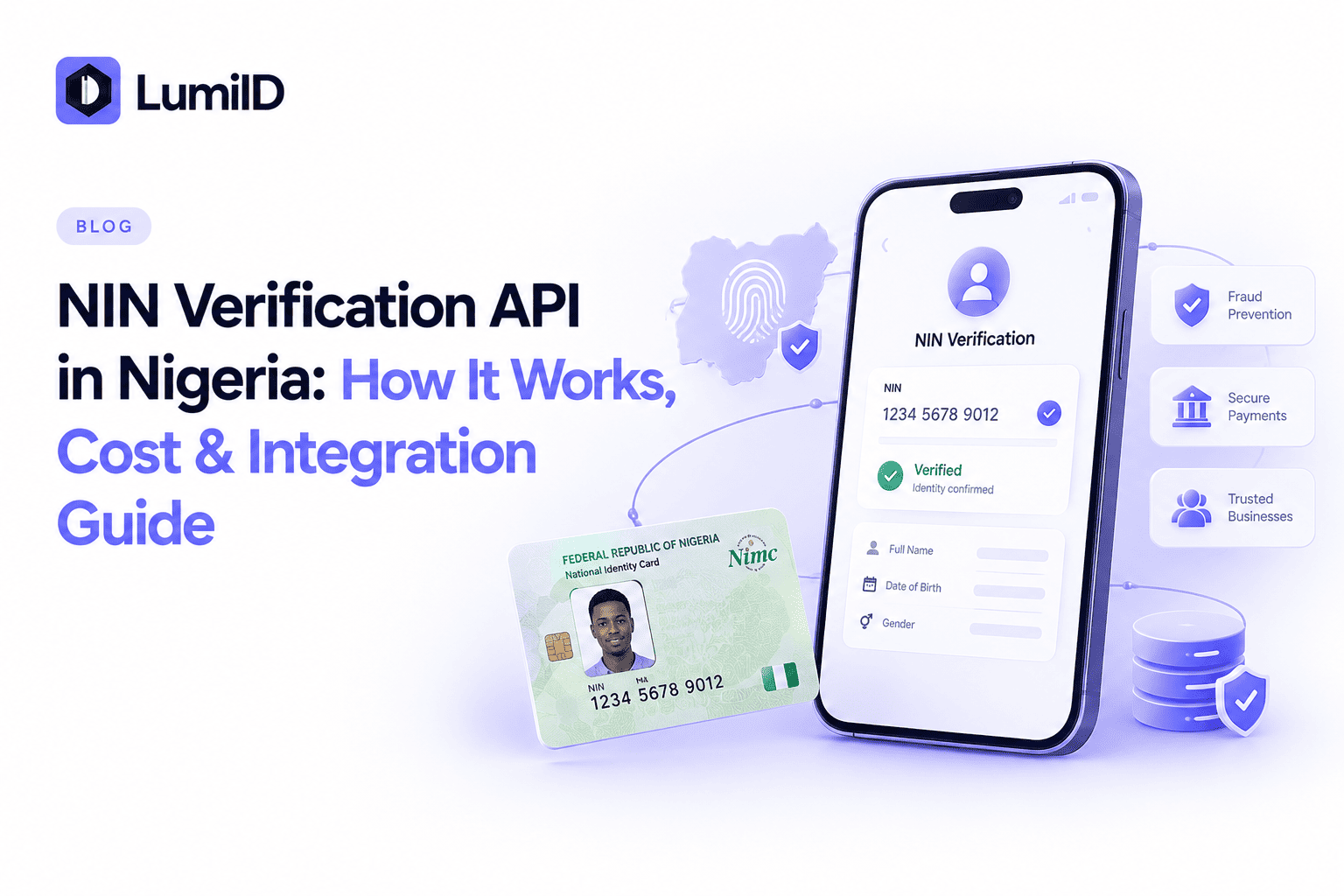
A NIN verification API lets your software send a NIN to a provider and get back a response that confirms whether the number exists and, depending on the service, returns or matches the identity data attached to it. Instead of an agent checking a slip by eye, your system gets a structured, machine-readable answer in seconds.
You will see three terms used loosely, and the differences matter when you compare vendors:
NIN lookup returns the record's details (name, date of birth, and so on) for a given NIN.
NIN validation checks details you already hold, such as the name and date of birth a customer typed in, against the record and tells you whether they match.
NIN verification with biometrics goes further and compares a live selfie to the portrait held against the NIN, so you learn whether the person presenting the number is its owner.
How a NIN Verification Check Works
Behind a single API call, several steps happen:
- Your app collects the NIN and, where required, the customer's consent. Many providers require you to confirm consent has been captured.
- Your request goes to the provider, typically with an API key, the NIN, and optional details to cross-check.
- The provider queries the authoritative source. The record is checked against government identity data rather than trusting what the customer typed.
- The response comes back. It tells you whether the NIN is valid and, depending on your plan, returns the matching fields or a per-field match result.
- Your system decides. Approve, reject, or route to extra checks based on the result and your risk rules.
A good integration treats this as one input to a decision, not the decision itself. A NIN that exists proves the number is real. It does not prove the person submitting it is the owner. That is why serious flows pair the lookup with a selfie and liveness check.
What Data Does a NIN Lookup Return?
This varies by provider and by what the customer consented to share, but typical responses include name fields, date of birth, facial image, gender, phone number and address details and somethings next of kin details (depending on access level).
Ask any provider exactly which fields come back, how mismatches are reported, and whether you get a per-field match score or only a pass or fail. Per-field results let you accept a name written in a different order while still catching a genuine mismatch.
What Does NIN Verification Cost?
Pricing in this market is not standardised, and the figures people quote are often not like-for-like.
Publicly listed prices vary widely. At the low end, one Nigerian payments provider lists NIN verification at ₦60 per check. A global KYC vendor lists $0.20 per successful query and $0.35 when a selfie match is included. Those figures cover different products, so compare what each price includes, not just the number.
Common pricing models. Industry guidance on [KYC pricing in Nigeria] describes per-verification pricing that usually falls as volume grows, with some providers bundling checks into packages or session fees.
Questions that change the real cost:
- Do you pay only for successful or conclusive results, or for every call?
- Are retries billed separately?
- Is pricing per check or per user session?
- Does the price include selfie matching and liveness, or are those extras?
- Do volume discounts exist, and at what thresholds?
- What happens to billing when the upstream source is down?
How to lower your effective cost. The biggest saver is not a cheaper rate. It is fewer repeat calls. When customers pass on the first attempt, you avoid paying for retries, so clear input validation, specific error messages, and a good capture experience reduce spend directly. Matching verification depth to risk also helps: you do not need the full biometric flow for every low-risk action.
How to Integrate a NIN Verification API
The mechanics are simple. The details that decide your conversion rate are in the design.
1. Validate input before you call. A NIN is 11 digits. Catch typos and wrong lengths in the form so you never pay for a call that was bound to fail.
2. Capture consent clearly. Show what you are checking and why, and record the consent. It protects you and builds trust.
3. Call from your backend, never the client. Keep API keys on your server and send results to the app, not the other way round.
4. Handle the response by status, not just success. Distinguish between a valid NIN, a NIN that does not exist, a NIN that exists but fails your cross-check, a suspended NIN, and an upstream error. Each needs a different user message and a different next step.
5. Pair the lookup with a selfie and liveness check when the action warrants it, so you confirm ownership as well as existence.
6. Log everything for audit. Store the request time, result code, and decision, though not more personal data than you need.
7. Test your failure paths. Many teams only test the happy path and discover their error handling in production.
Handling the Errors That Cost You Customers
Most onboarding drop-off at the NIN step comes from poor handling of a few predictable situations.
Suspended NINs. A suspended record should not produce a generic "verification failed." A structured, specific response code lets your app tell the user what happened and what to do next, instead of leaving them at a dead end.
Name and date mismatches. Differences in name order, spelling, or format are common. Use per-field match results and sensible tolerances rather than rejecting on the first discrepancy.
NINs that cannot be found. Offer a clear route to re-enter the number or contact support, and separate typos from genuinely invalid numbers.
Upstream downtime. This is the one most teams are unprepared for.
When the NIN Verification System Goes Down
Your provider can be perfectly healthy while the source it depends on is not. In March 2026, a weeks-long failure of the NIN portal stopped SIM registrations and swaps across all the major networks, and the same report noted a similar disruption in July 2025. It also affected bank verifications and other services that depend on NIN checks.
For a fintech, an outage like that turns into a queue of customers you cannot onboard. Plan for it:
Detect it quickly. Monitor for a spike in upstream errors or timeouts so you know the problem is the source, not your integration.
Fail gracefully. Tell users plainly that verification is temporarily unavailable instead of showing a generic error.
Queue and resume. Let users save progress and return, or complete the check automatically once the source recovers.
Use tiered limits. Where your risk policy and regulator allow, offer limited functionality while a full check is pending rather than blocking the customer entirely.
Know your fallback. Decide in advance whether an alternative verification route, such as BVN or document checks, is acceptable for your risk level and the account tier.
Compliance: What the Rules Expect
Under CBN account-tiering rules, higher-tier individual accounts require both BVN and NIN, while the lowest tier requires at least one. Verifying against the authoritative source, rather than collecting a number and trusting it, is how businesses show they met that expectation.
On the data side, handle NIN data in line with Nigeria's data protection rules, including the NDPR and the Nigeria Data Protection Act 2023: collect only what you need, record consent, limit retention, and secure what you store. Check with your compliance adviser for how this applies to your specific licence and use case.
Why Verification Alone Isn't Enough: Fraud Around the NIN
A valid NIN is not proof of identity. Investigative reporting in 2026 described how NIMC-accredited centres have helped some people obtain multiple national ID registrations, and earlier reporting has described regulators acting against enrolment abuse. At the same time, stolen or sold identity details circulate, and attackers present real numbers with someone else's face.
That is why strong flows combine a source-of-truth lookup with a selfie, passive liveness detection, and fraud scoring on the behaviour around the check, such as repeat attempts, unusual timing, and device signals.
How to Choose a NIN Verification API Provider
- Source and coverage. Does the provider query the authoritative source directly, and how does it behave when that source is slow or offline?
- Response quality. Per-field match results, specific error codes, and clear handling of suspended records.
- Biometrics. Selfie matching and liveness that work on mid-range phones and across skin tones.
- Pricing transparency. Clear billing for retries, failures, and downtime, with volume tiers you can plan around.
- One platform or many. Whether NIN, BVN, CAC, and TIN checks sit behind one integration or several.
- Developer experience. Documentation, sandbox access, SDKs, and support that answers quickly.
- Analytics. Visibility into where users fail so you can fix the flow, not just count the failures.
- Data protection. Clear handling of personal data and a defensible compliance posture.
How LumiID Handles NIN Verification
LumiID puts NIN, BVN, CAC, TIN, NUBAN and more checks behind a single API, so you integrate once instead of stitching together vendors. NIN results come back in real time, and a suspended NIN returns a structured NIN_SUSPENDED response so your product can give users a specific, useful message.
For stronger assurance, you can pair the lookup with selfie verification and passive liveness that needs no gestures, and run the whole event through Kura, our fraud engine, which applies more than 34 rules calibrated to Nigerian fraud patterns and tracks velocity in real time. Verification analytics show where users drop off, with PDF and Excel exports for regular reporting. We do not store raw biometric data, and our practices are built around NDPR compliance.
If you are comparing NIN verification APIs, talk to the LumiID team about your volumes and use case.
FAQ
What is a NIN verification API? It is a service your software calls to check a National Identification Number against government identity data and get a structured result, so you can confirm identity during onboarding without manual review.
How much does NIN verification cost in Nigeria? Listed prices range from tens of naira per check at some local providers to roughly 20 to 35 US cents at global vendors, depending on whether selfie matching is included. Compare what each price covers, and ask how retries and failed calls are billed.
What is the difference between NIN lookup and NIN validation? A lookup returns the details held against a NIN. Validation checks details you already have, such as a typed name and date of birth, against the record and reports whether they match.
Can I verify a NIN with a selfie? Yes. Some services compare a live selfie to the portrait held against the NIN, which confirms the person presenting it is the owner. Pair it with liveness detection to block spoofing.
Is NIN verification required for Nigerian fintechs? CBN account-tiering rules require BVN and NIN verification for higher-tier individual accounts, with at least one required at the lowest tier. Confirm the exact requirements for your licence with your compliance team.
What should I do when the NIN verification system is down? Detect upstream failures quickly, tell users clearly that verification is temporarily unavailable, let them save progress and resume, and use tiered limits or an approved fallback check where your risk policy allows.
Why does a NIN show as suspended? Suspension can follow enrolment irregularities such as duplicate registrations or data problems. Users generally need to resolve it with NIMC, so your product should show a clear message and next step rather than a generic failure.