NIN vs vNIN vs BVN: Which Should You Verify, and When?
Nigerian customers carry three numbers that all seem to say "this is who I am": the NIN, the vNIN, and the BVN. Product teams often treat them as three ways of asking the same question, so they pick one and move on. That's how businesses end up verifying a number that proves the wrong thing, or asking customers for a number they shouldn't be collecting at all.
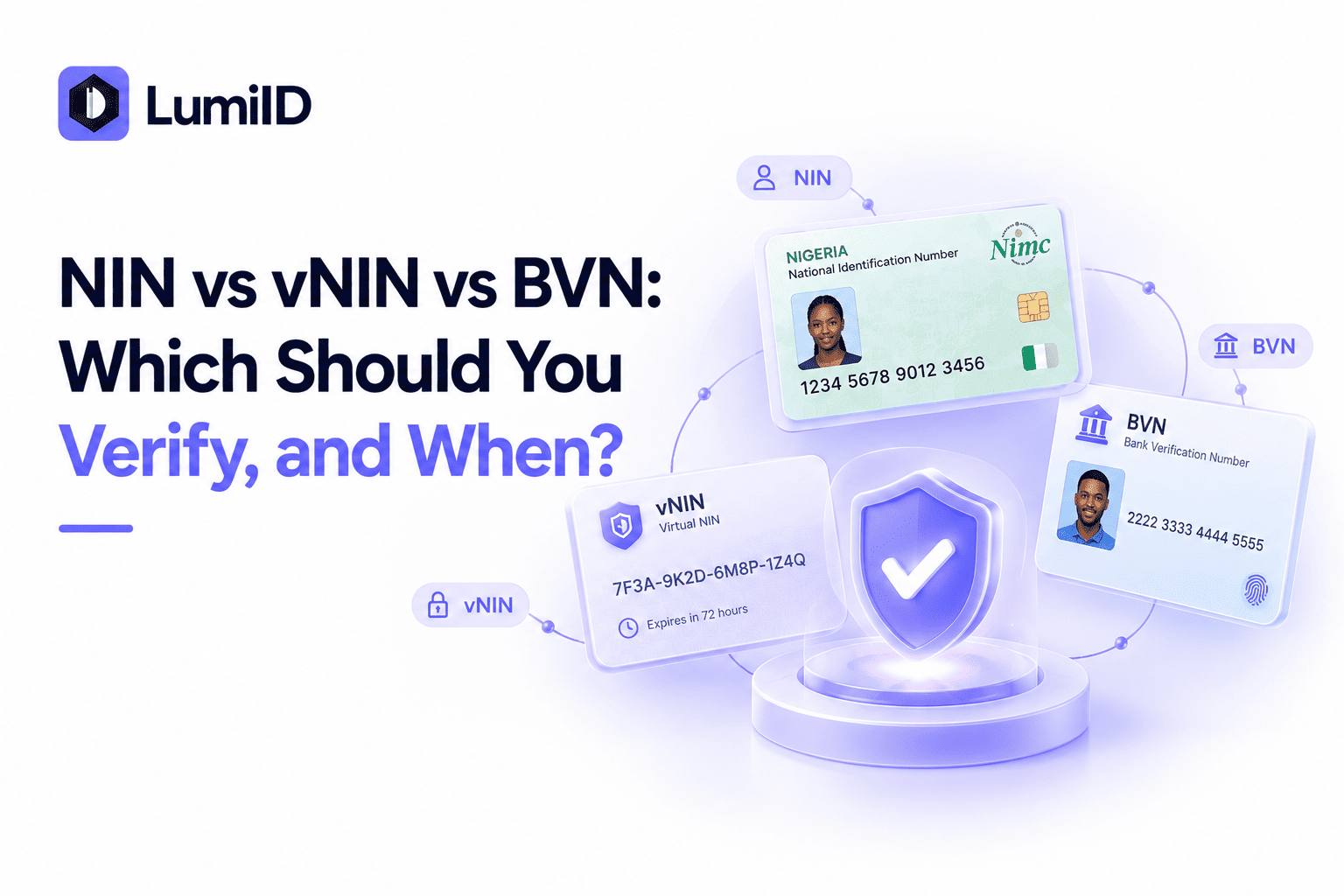
The short version: the NIN is your national identity, the vNIN is a temporary token that lets you prove the NIN without exposing it, and the BVN is your banking identity. This guide explains what each proves, how they differ, and which to verify for onboarding, lending, and compliance.
NIN vs vNIN vs BVN at a Glance
| NIN | vNIN | BVN | |
|---|---|---|---|
| What it is | National Identification Number | Temporary token tied to a NIN | Bank Verification Number |
| Issued by | NIMC | Generated by the NIN holder through NIMC channels | CBN, through NIBSS |
| Format | 11 digits | 16 alphanumeric characters | 11 digits |
| Who has one | Citizens and legal residents | Any NIN holder, on demand | People with bank accounts |
| Lifespan | Permanent | Expires after 72 hours, single use | Permanent |
| What it proves | Legal identity | That the NIN holder consented to this check | Banking identity, linked to biometrics and accounts |
| Main use | Government services, KYC, SIM registration | Sharing identity with a business without exposing the NIN | Bank and fintech KYC, fraud tracking |
What Is a NIN?
The National Identification Number (NIN) is the 11-digit identifier issued by the National Identity Management Commission (NIMC). It is the legal identity record for Nigerian citizens and legal residents. Reporting in late 2025 put enrolment at roughly 123.9 million people, so it reaches far more people than the banking system does.
A NIN tells you someone is enrolled in the national identity database and what demographic details are held against that record. It doesn't tell you anything about their financial history.
What Is a vNIN?
A virtual NIN, or vNIN, is a tokenised version of the NIN. It is generated through the NIMC mobile app or a USSD code, requires a phone number linked to the NIN, and expires 72 hours after it is created. It is a 16-character alphanumeric string that doesn't resemble the underlying NIN, and it works once.
The reason it exists is data protection. NIMC's tokenisation approach means a customer can prove their identity to a business without handing over the raw NIN, and the business can't reuse the token later. Industry guidance also says a vNIN shouldn't be stored in your database. It is for verification, not record-keeping.
NIMC's direction has been tightening around consent. In September 2026, the commission described its NINAuth platform as requiring the explicit consent of the NIN holder before personal data is shared for KYC, with the stated goal of letting people verify without exposing their raw NIN. NIMC also says this reflects the NIMC Act 2026 and the Nigeria Data Protection Act 2023. Check with your verification provider which route they use to reach NIMC data, because it affects what your customer must do during onboarding.
What Is a BVN?
The Bank Verification Number (BVN) is an 11-digit biometric identifier introduced by the CBN in 2014 and operated through NIBSS. When someone enrols, their fingerprints and photograph are captured and tied to the number, and the same BVN follows them across every bank account they hold. By December 2025, NIBSS recorded about 67.8 million BVN registrations.
A BVN tells you the person has gone through bank-grade enrolment and gives you a hook into banking-specific signals, such as cross-bank identity and fraud monitoring. It only covers people who have bank accounts, so a customer with no bank history simply won't have one.
How NIN and BVN Relate
They are linked, not merged. Banks have been required to connect customers' BVNs to their NIN records, and the CBN moved to restrict accounts that lacked a BVN or NIN from April 2024. But the BVN still lives in NIBSS and the NIN still lives in NIMC, and each reflects a different enrolment event. That's why a customer's name or date of birth can differ between the two, and why a mismatch deserves attention rather than automatic rejection or approval.
Which Should You Verify, and When?
The right answer depends on what you need to prove and what the regulator expects for the account tier.
Basic wallet or low-limit account. The lowest account tier requires at least one of BVN or NIN under CBN tiering rules. A NIN check, via vNIN or a consent-based route, is the more inclusive choice because it covers people who aren't yet banked. Pair it with a selfie so you know the person is the owner.
Higher-tier accounts and larger limits. CBN tiering requires both BVN and NIN for Tier 2 and Tier 3 individual accounts. Verify both and cross-check the names and dates of birth. The 2026 Baseline Standards are reported to treat real-time BVN lookups through NIBSS and NIN lookups through NIMC as the minimum for automated KYC, so self-declaration isn't enough.
Lending and credit. Verify both. The NIN anchors legal identity, and the BVN connects to banking identity and fraud signals. Lenders rely on the combination because each number covers gaps in the other.
Unbanked or thin-file customers. Lean on the NIN with a biometric match, since a BVN may not exist. Be explicit in your risk policy about what limits apply until a bank relationship is established.
Sharing identity with a third party. If you are the customer asking a business to verify you, offering a vNIN protects your raw NIN. If you are the business, don't ask customers to type their NIN into a free-text field when a consent-based route is available.
Businesses and corporate customers. The NIN and BVN verify the individuals behind the company. Add CAC and TIN checks for the entity itself.
Diaspora customers. The CBN and NIBSS launched a non-resident BVN platform in 2025 so Nigerians abroad can obtain a BVN remotely, which matters if you serve that segment.
Why Verifying Both Beats Verifying One
Each number has blind spots. A valid NIN proves the record exists, not that the person in front of you owns it. A valid BVN proves banking enrolment, not that the applicant is who they claim. Checking both and comparing the returned details gives you a much stronger signal:
- Names and dates of birth that match across both are a strong positive sign.
- Small differences such as name order or a spelling variant usually deserve a tolerant match rule rather than a rejection.
- Large differences may indicate a borrowed or synthetic identity and should trigger extra checks.
Neither number replaces a biometric check. A real number presented by the wrong person passes a database lookup every time, which is why serious flows add a selfie and liveness detection.
Common Mistakes to Avoid
Storing vNINs. The token is single-use and short-lived, and guidance says it shouldn't be kept. Treat it as transient.
Letting the token expire mid-flow. A customer who generates a vNIN and finishes the form days later will fail. Design the flow so the token is generated and used in one sitting, and explain it clearly to the user.
Asking for the raw NIN when you don't need to. It increases your data exposure and compliance burden for no benefit.
Treating existence as ownership. Validating a number isn't the same as confirming the person. Add biometrics.
Rejecting on every mismatch. Name-order and formatting differences are common. Use per-field results.
Giving generic errors. A suspended NIN, a token that expired, and a number that wasn't found each need a different message and next step.
How LumiID Handles NIN and BVN Verification
LumiID puts NIN, BVN, CAC, TIN, and NUBAN checks behind a single API, so you can run the NIN and BVN checks together and compare the results without stitching together vendors. If a NIN is suspended, we return a structured NIN_SUSPENDED response so your product can show a specific message instead of a dead end.
For stronger assurance, pair the lookups with selfie verification and passive liveness that needs no gestures, and run the whole event through Kura, our fraud engine, which applies more than 34 rules calibrated to Nigerian fraud patterns and tracks velocity in real time. We don't store raw biometric data, and our practices are built around NDPR compliance.
Not sure which checks your onboarding flow needs? Talk to the LumiID team about your account tiers and use case.
FAQ
What is the difference between NIN and BVN? The NIN is your national identity, issued by NIMC to citizens and legal residents. The BVN is your banking identity, issued through NIBSS to people with bank accounts and tied to fingerprints and a photo. They are linked but stored in different systems.
What is a vNIN? A virtual NIN is a 16-character token generated from your NIN through NIMC's app or USSD. It lets a business verify you without seeing your raw NIN, expires after 72 hours, and can be used once.
Is a vNIN the same as a NIN? No. The vNIN is a temporary token derived from the NIN. It has a different format, a short lifespan, and doesn't reveal the underlying number.
Can a vNIN be reused? No. It works once and expires after 72 hours. If a check fails because of a network issue, the token may still be valid within that window, but a successful verification uses it up.
Do I need both a BVN and a NIN? For higher-tier individual accounts, CBN rules require both. At the lowest tier, at least one is needed. Check the current requirements for your licence and account tiers.
Has the NIN replaced the BVN? No. Both remain in use. Banks link them, but the BVN stays in the NIBSS database and the NIN stays with NIMC.
Why do my BVN and NIN show different names? They come from separate enrolment events, so spelling, name order, or date-of-birth entries can differ. Use tolerant matching, and escalate large differences for review.
Should I store a customer's NIN or vNIN? Store as little as you can. A vNIN is single-use and shouldn't be kept, and you should hold the raw NIN only if you have a clear, lawful need and proper safeguards.