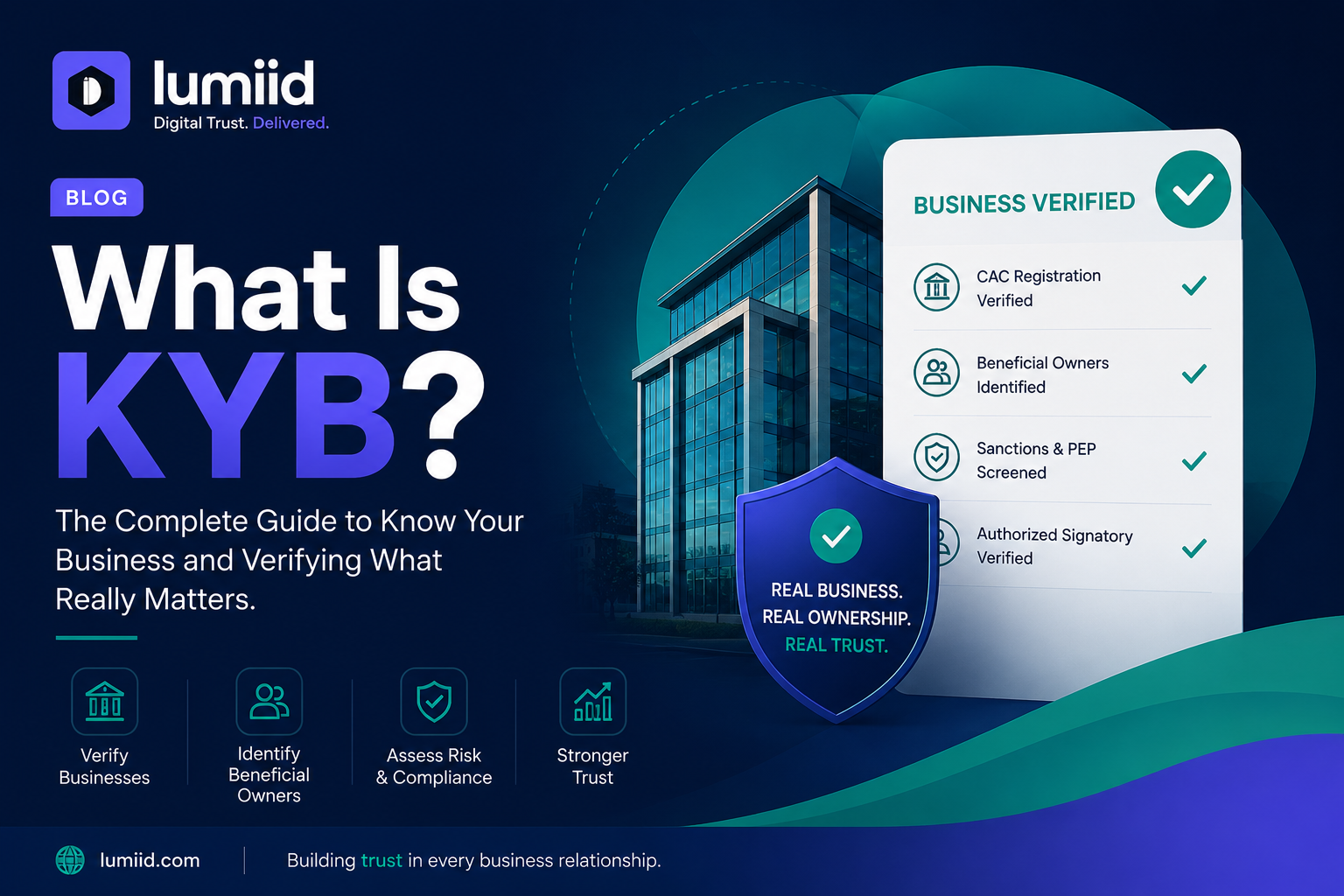
What is KYB?
Before a bank, fin tech, or marketplace starts doing business with another company, it needs to answer a simple question:
Is this business really who it claims to be?
That's the purpose of Know Your Business (KYB).
KYB is the process businesses use to verify that a company is legally registered, actively operating, and owned or controlled by identifiable people before establishing a business relationship. Whether it's opening a corporate bank account, on-boarding a merchant, or approving a payment partner, KYB helps organizations confirm they're dealing with a legitimate business rather than a fraudulent or high risk entity.
Think of it this way: KYC verifies people, while KYB verifies businesses. Instead of checking an individual's identity, KYB focuses on the company itself, its legal registration, ownership structure, and the people who ultimately control it. And just like KYC, KYB isn't something you do once and forget. As businesses grow and ownership changes, ongoing monitoring helps ensure the information remains accurate and up to date.
In Nigeria, the process usually begins with the Corporate Affairs Commission (CAC). A CAC search using a business name or RC number confirms that a company exists in the official register. While this is an important first step, it's only part of the verification process.
A business may be legally registered but no longer active. It could have changed ownership, fallen out of good standing, or even be used by someone with no legitimate connection to it. That's why checking the CAC register alone doesn't provide the complete picture. It confirms that a business exists, but it doesn't necessarily confirm that it's trustworthy.
One area many organizations overlook is beneficial ownership.
Nigeria's 2026 compliance framework requires registered companies to identify and report individuals who qualify as Persons with Significant Control (PSC) through the CAC's Open Ownership Register. Nigeria sets this threshold at 5% ownership, one of the lowest among comparable jurisdictions. This reflects a growing global effort to increase transparency around who really owns and controls businesses and to make it harder for bad actors to hide behind complex ownership structures.
This is also part of a broader regional initiative. Under ECOWAS Directive C/DIR.2/07/23, all 15 West African member states are expected to establish central beneficial ownership registers by January 2027, with countries such as Nigeria, Ghana, and Senegal already leading implementation.
At its core, a complete KYB process should answer three important questions:
· Is this business legally registered?
· Is it still in good standing?
· Do we know who really owns and controls it?
When you can confidently answer all three, you're no longer just verifying a business. You're building the trust needed to do business with confidence.
KYB vs KYC
We briefly introduced the difference between KYC and KYB in our KYC guide, but it's worth taking a closer look because this is where many businesses unknowingly leave gaps in their on-boarding process.
The confusion usually isn't about what the two terms mean. It's assuming that completing one automatically covers the other.
It doesn't.
The difference is simple:
KYC verifies a person. KYB verifies a business.
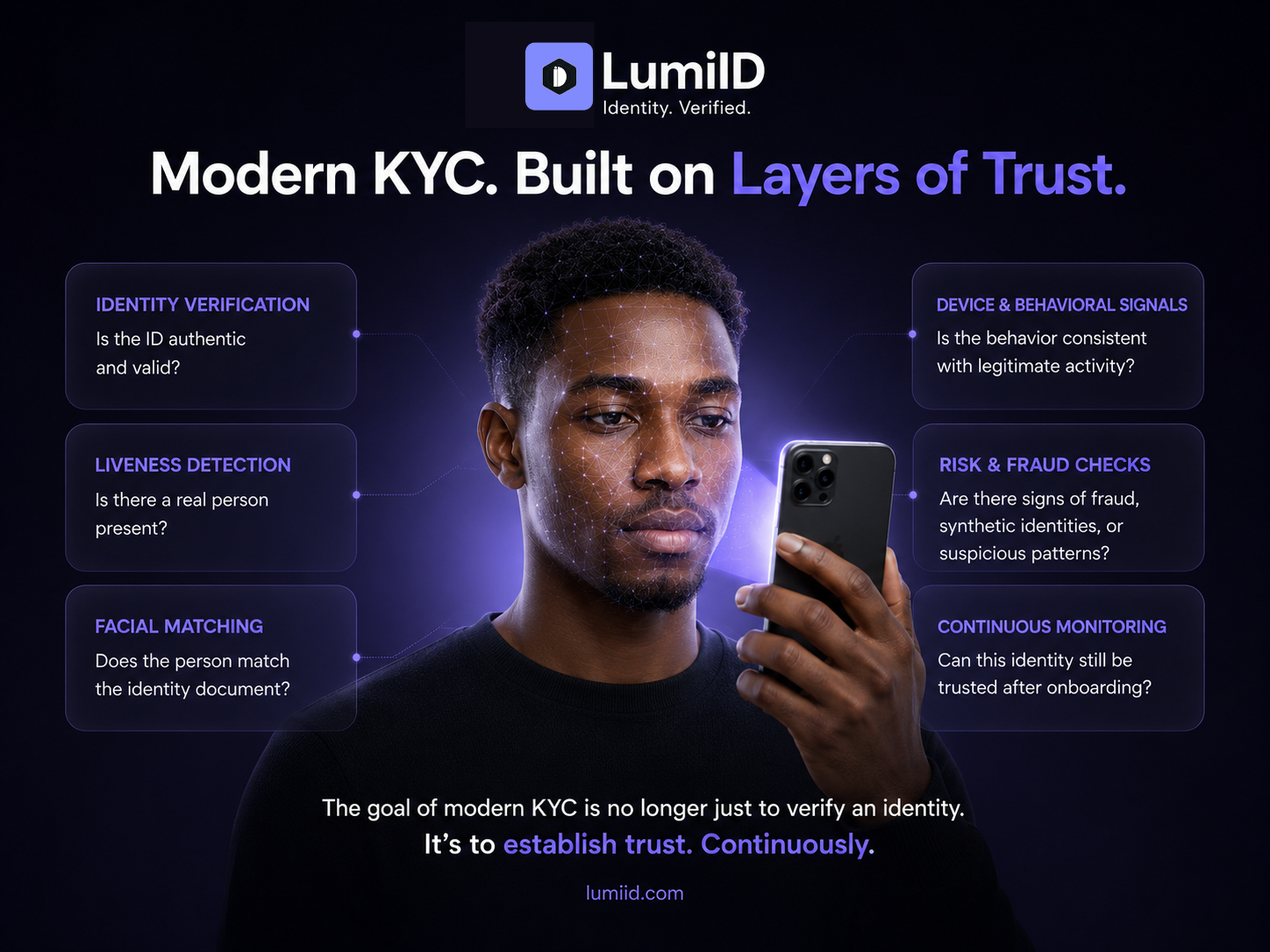
If you're on boarding a corporate customer, a merchant, or a business partner, you need both.
A complete on-boarding process verifies the business itself through KYB while also verifying the people connected to that business through KYC.
In Nigeria, that typically means:
· KYC verifies the company's directors and beneficial owners using identifiers such as BVN and NIN, following the same risk based framework discussed in our KYC guide.
· KYB verifies the business itself using CAC registration records, its good standing status, company formation details, and information from the Open Ownership Register.
One of the biggest mistakes businesses make is stopping after the CAC verification.
Imagine a company successfully passes its registration check. The RC number is valid, the business exists, and everything appears legitimate. Many platforms approve the account at this point.
But there's one important question left unanswered:
Is the person opening this account actually authorised to represent the business?
A CAC search can't answer that.
It confirms the company exists, but it doesn't tell you whether the individual completing the onboarding process is one of its directors, beneficial owners, or an authorised representative.
That missing verification creates one of the biggest gaps in business onboarding. Fraudsters rarely create fake companies from scratch. More often, they misuse genuine businesses by acting on behalf of companies they have no legitimate authority to represent.
A simple way to test your onboarding process is to ask yourself two questions:
· Can we verify that this business is genuine?
· Can we verify that this person is authorised to act on behalf of that business?
If you can answer the first question but not the second, you've completed KYB without completing KYC and that's exactly the kind of gap fraudsters look for.
What a KYB Check Includes
A complete KYB check involves much more than confirming that a business is registered. It's a series of checks, each designed to answer a different question about the company you're about to do business with.
As your business grows, how you perform these checks becomes just as important as the checks themselves. Manually reviewing a handful of businesses each month might be manageable, but once you're on-boarding dozens or even hundreds of merchants, vendors, or corporate customers, the process can quickly become slow, inconsistent, and difficult to scale.
Here's what a comprehensive KYB check typically includes.
- Confirm the business exists and is legally registered
Everything starts with verifying that the business is officially registered.
In Nigeria, this means checking the Corporate Affairs Commission (CAC) using the company's RC number or registered business name. Rather than relying on someone to manually search the CAC portal, most modern verification systems perform this check automatically as soon as a business begins the on-boarding process.
There are generally two levels of verification:
· Basic verification confirms key details such as the company's registration status, business type, and registered address. This is often sufficient for basic supplier checks or low-risk on-boarding.
· Advanced verification provides a much deeper view, including information about the company's directors, shareholders, and ownership structure. This is the level of verification required for a robust KYB process.
One common mistake businesses make is assuming that a successful CAC search means KYB is complete.
It doesn't.
A registration check simply confirms that the company exists. It doesn't tell you who controls the business, whether ownership has changed, or whether the people acting on behalf of the company are actually authorized to do so.
- Confirm the business is in good standing
Being registered doesn't automatically mean a business is compliant.
A company may still exist on the register while failing to meet important regulatory obligations. For example, businesses are expected to file annual returns with the CAC, and consistently failing to do so can eventually lead to the company being struck off the register.
Checking a company's standing helps you understand whether it is still operating in compliance with its legal obligations not just whether it was registered at some point in the past.
- Identify the beneficial owners
Once you've confirmed the business exists, the next step is identifying who really owns and controls it.
This is where many organizations discover the biggest gaps.
A company may appear legitimate on paper, but the individuals making decisions behind the scenes aren't always obvious from the registration documents alone.
To close this gap, KYB checks reference the CAC Open Ownership Register to identify every Person with Significant Control (PSC) based on Nigeria's 5% ownership threshold.
Understanding beneficial ownership provides a much clearer picture of who ultimately benefits from, controls, or influences the business.
- Screen owners against sanctions and risk lists
Knowing who owns the business is only part of the process.
The next step is determining whether any of those individuals present a compliance or financial crime risk.
Beneficial owners are typically screened against sanctions lists, watch lists, and Politically Exposed Persons (PEP) databases. This helps businesses identify potential links to money laundering, terrorism financing, corruption, or other high-risk activities before establishing a commercial relationship.
This screening process is also a key part of broader AML compliance requirements.
- Verify the person signing up is actually authorized
This is one of the most important and most frequently overlooked steps in business on-boarding.
Even if the business passes every verification check, there's still one question that needs to be answered:
Is the person creating this account actually authorized to represent the company?
A valid CAC registration won't tell you that.
The individual completing the on-boarding process should be verified as a registered director, beneficial owner, or someone officially authorized to act on the company's behalf.
Skipping this step creates one of the biggest opportunities for fraud. A genuine company can still be misused if someone with no legitimate connection to it is able to open and operate an account in its name.
Why KYB becomes more challenging as your business grows
Many businesses assume verification becomes easier once they've built a process.
In reality, the opposite is usually true.
As onboarding volumes increase, manual reviews become harder to manage. Compliance teams spend more time switching between systems, reviewing documents, and waiting for verification results. Before long, onboarding slows down, merchants sit in review queues, and customer experience begins to suffer.
This is one of the key reasons behind the CBN's 2026 push towards greater automation. Modern compliance isn't just about performing checks it's about performing them consistently, accurately, and in real time.
Where onboarding delays usually happen
Many people assume the biggest bottleneck is verifying whether a business is registered.
In practice, that's rarely the case.
Most Nigerian businesses pass the initial CAC registration check without any issues. The real delays usually begin when it's time to verify beneficial ownership.
Ownership records don't always reflect the current reality, particularly for older companies or businesses that have gone through ownership changes without promptly updating their records. In some cases, the people who originally registered the company are no longer the ones who control it.
That's why the biggest challenge isn't confirming that a business exists.
It's confirming who truly owns and controls it today.
KYB for Marketplaces & Fin techs
Every business that works with other businesses can benefit from KYB, but for marketplaces and fin techs, the stakes are even higher.
Unlike traditional banks that may onboard a relatively small number of corporate customers, fin techs and digital marketplaces often process hundreds or even thousands of business applications. The challenge is finding the right balance between speed and trust. Customers expect a fast on boarding experience, but regulators expect thorough due diligence. Delivering both isn't always easy.
The unique risk marketplaces face
When people think about business fraud, they often imagine fake companies with forged registration documents.
In reality, that's rarely the biggest problem.
Most marketplaces don't lose money because someone invented a business that doesn't exist. Basic CAC verification usually catches that straight away.
The bigger risk is far more subtle.
A business may be legally registered and appear completely legitimate, but the person trying to open the account has no real authority to represent it. In some cases, the company may have stopped operating years ago. In others, it could be a shell company or a legitimate business that's being used by someone with fraudulent intentions.
This is why verifying who is acting on behalf of the business is just as important as verifying the business itself.
For marketplaces, fraud often starts with the wrong person controlling a real company, not a fake company pretending to be real.
How this challenge looks for fin techs
Fin techs face a slightly different version of the same problem.
Whether it's opening a corporate wallet, issuing a payment terminal, or on-boarding a business for digital payments, the biggest risk isn't always at the point of sign up.
The real challenge begins after the business has been on-boarded.
A company that appears low risk today can become high risk tomorrow. Its ownership may change, transaction volumes may increase unexpectedly, or its payment behaviour may shift in ways that weren't anticipated during on-boarding.
That's why KYB shouldn't be treated as a one-time verification exercise.
Just as KYC requires ongoing customer monitoring, KYB should also continue throughout the business relationship. Monitoring changes in ownership, business activity, and risk profile helps organizations identify potential issues before they become compliance or fraud problems.
Fast on-boarding doesn't have to come at the expense of compliance
There's a common belief that stronger verification automatically leads to slower on-boarding.
That might have been true when every check relied on manual reviews and paperwork.
Today, it doesn't have to be.
With automated, API-driven KYB, businesses can verify company registration, confirm beneficial ownership, perform sanctions screening, and validate authorized representatives in real time all while the customer completes the on-boarding process.
Instead of waiting days for manual reviews, legitimate businesses can be approved in minutes, creating a better experience for customers without compromising compliance.
In other words, speed and security no longer have to compete. With the right verification infrastructure, they can work together.
The fraud pattern businesses should pay the most attention to
One insight that's often overlooked is that completely fabricated businesses are usually the easiest to detect.
If a business name doesn't match CAC records or the registration details don't exist, the verification process flags the issue almost immediately.
The more difficult cases involve businesses that are genuinely registered.
These companies have valid RC numbers, appear legitimate on paper, and pass basic registration checks. The problem lies elsewhere. The person attempting to use the business may not be a director, beneficial owner, or authorized representative at all.
That's why asking "Is this business real?" is only half the equation.
The more important question is:
"Is this the right person acting on behalf of this business?"
Businesses that answer both questions are far better positioned to prevent fraud, reduce compliance risk, and build trusted business relationships from the very beginning.
Automating KYB with an API
Every step we've covered so far from verifying CAC registration to checking beneficial ownership and screening against sanctions lists can be done manually.
The real question is whether it should be.
If you're only verifying a handful of businesses each month, manual checks may be manageable. But as your customer base grows, that approach quickly becomes difficult to sustain. Compliance teams spend more time switching between systems, searching government databases, and reviewing documents than they do making informed risk decisions.
That's where API-driven KYB changes the picture.
Instead of treating verification as a series of disconnected manual tasks, an API brings the entire process together into a single, automated workflow that runs in the background while a business completes its on-boarding.
What an API-driven KYB check actually does
With an API, there's no need for someone to manually search the CAC portal every time a new business signs up.
As soon as a company submits its RC number or business name, the system can automatically retrieve structured information such as:
· Registration status
· Business type
· Registered address
· Company directors
· Shareholders
· Beneficial ownership information
Rather than receiving scattered records from different sources, your platform gets consistent, structured data that can immediately feed into your on-boarding and risk assessment process.
Whether the company was registered six months ago or fifteen years ago, the information is returned in the same predictable format, making it much easier to automate business verification at scale.
Why structured data matters
This might sound like a small detail, but it's one of the biggest advantages of using a verification API.
Government records aren't always stored in a way that's easy for software or even people to interpret.
A director's name might appear differently across different databases. Company addresses may be incomplete or formatted inconsistently. Even registration statuses can vary depending on how the information was originally recorded.
If your team has to manually interpret those differences every time a business signs up, on-boarding quickly becomes slow and inconsistent.
A verification API removes that complexity by standardizing the data before it reaches your platform.
Instead of asking your compliance team to interpret raw records, your system receives clean, consistent information in the same format every time, allowing automated risk rules and on-boarding decisions to work as intended.
Two ways to integrate KYB into your business
Not every organization has the same verification needs, which is why KYB solutions are typically offered in two ways.
API integration
This option is designed for businesses that want verification to happen automatically during on-boarding.
The moment a company submits its information, the API performs the necessary checks and returns the results directly to your platform. Based on your own risk rules, the customer can be approved immediately, flagged for additional review, or declined.
This approach is ideal for fin techs, payment providers, digital marketplaces, and other businesses on-boarding customers at scale.
No-code dashboard
Some organisations don't need real-time automation.
For compliance teams carrying out occasional supplier verification, vendor due diligence, or one-off business checks, a dashboard provides a simple way to perform KYB without involving engineering teams.
While this works well for lower volumes, it doesn't eliminate the manual review process the way API integration does.
What an automated KYB workflow looks like
Here's what the process typically looks like from start to finish.
A business enters its RC number or registered business name during signup.
The verification system automatically checks the CAC register and retrieves the company's registration details.
It then identifies the company's beneficial owners and screens them against sanctions lists and Politically Exposed Persons (PEP) databases.
Within seconds, your platform receives a structured response that allows your on-boarding workflow to decide whether to:
· Approve the business
· Flag it for manual review
· Decline the application
All of this happens without someone manually searching government databases or moving information between multiple systems.
How Lumiid simplifies KYB
This is exactly where Lumiid adds value.
Rather than asking your compliance team to juggle multiple verification tools, Lumiid brings the entire KYB process together through a single integration.
With one API call, businesses can verify CAC registration, identify beneficial owners, screen directors and owners against sanctions and watch lists, and receive structured verification results within seconds.
The result is a faster on-boarding experience for legitimate businesses, less manual work for compliance teams, and stronger protection against fraud.
What could take a compliance analyst hours or even most of a working day to complete manually can be automated in the time it takes a merchant to finish filling out an on-boarding form.
That's the real value of automation.
It doesn't just make KYB faster.
It makes it more consistent, more scalable, and far easier to manage as your business grows.
Frequently Asked Questions (FAQs)
Is KYB required by law in Nigeria?
Yes. For banks, fin techs, lenders, and other regulated businesses, KYB forms part of Nigeria's anti-money laundering (AML) and compliance framework.
Businesses are expected to verify the identity of the companies they work with, not just the individuals representing them. In addition, Nigeria's 2026 compliance framework requires registered entities to disclose their beneficial owners through the CAC's Open Ownership Register, strengthening transparency around business ownership.
Can KYB be automated?
Absolutely.
In fact, once you're on-boarding businesses at any meaningful scale, automation quickly becomes a necessity rather than a luxury.
A modern KYB solution can verify a company's registration, identify beneficial owners, screen directors and owners against sanctions and PEP lists, and return results within seconds. What would otherwise involve multiple manual searches across different systems can be completed through a single automated workflow.
What information is needed for a KYB check?
At the very least, you'll need a valid CAC registration number (RC number) or the business's registered name.
For more comprehensive verification, you'll also need information about the company's directors and beneficial owners. This allows the verification process to confirm ownership, assess risk, and complete sanctions and compliance screening.
What is beneficial ownership, and why does the 5% threshold matter?
A beneficial owner is someone who ultimately owns, controls, or significantly influences a business, even if they aren't the person managing it day to day.
Nigeria uses a 5% ownership threshold when identifying Persons with Significant Control. This relatively low threshold makes it harder for individuals to hide ownership by spreading shares across multiple people or entities.
Knowing who really controls a business gives organizations a much clearer understanding of the risks associated with that relationship.
Is a CAC check the same as a KYB check?
No.
A CAC search is only one part of the KYB process.
It confirms that a business is legally registered, but it doesn't tell you whether the company is still in good standing, who ultimately owns it, or whether those owners present any compliance risks.
A complete KYB process goes further by identifying beneficial owners, verifying authorized representatives, and screening against sanctions and watch lists.
Does KYB replace KYC?
Not at all.
KYB and KYC work together to provide a complete picture.
KYB verifies the business itself, while KYC verifies the individuals connected to that business, such as directors, beneficial owners, and authorized representatives.
If you're on-boarding a corporate customer, you need both. Verifying the company without verifying the person acting on its behalf still leaves an important security gap.
Final Thoughts
A business registration certificate tells you one important thing:
The business exists.
What it doesn't tell you is whether the company is still operating, who really owns it, or whether the person opening an account has the authority to represent it.
That's where KYB makes the difference.
A well-designed KYB process helps you look beyond registration records to understand who you're really doing business with. By verifying business ownership, confirming authorized representatives, and continuously monitoring risk, organisations can reduce fraud, strengthen compliance, and build more trusted business relationships.
As regulations continue to evolve and digital onboarding becomes the norm, effective business verification is no longer just about meeting compliance requirements. It's about protecting your platform, your customers, and your reputation.
Simplify Business Verification with Lumiid
At Lumiid, we believe business verification should be both secure and seamless.
Our KYB solution helps fintechs, banks, marketplaces, and other regulated businesses verify Nigerian companies through a single, easy-to-integrate API. From CAC registration checks and beneficial ownership verification to sanctions screening and ongoing risk monitoring, Lumiid brings every stage of the verification process together in one place.
Instead of spending hours manually searching multiple databases, your team can receive structured verification results in seconds, allowing legitimate businesses to onboard faster while helping you identify risks before they become costly problems.
Whether you're verifying a single business or onboarding thousands every month, Lumiid gives you the confidence to make faster, smarter, and more compliant decisions.
Because trust doesn't start after onboarding. It starts with knowing exactly who you're doing business with.